Seventy-Two Hours to Brilliance: How the Pressure of Extreme Filmmaking Constraints Is Reshaping Independent Cinema
At precisely midnight on a Friday in cities across the country, hundreds of filmmakers receive an envelope. Inside it: a genre, a character, a prop, and a line of dialogue. They have seventy-two hours to write, shoot, edit, score, and submit a completed short film incorporating every assigned element. By Sunday night, the work is done—or it isn't.
This is the 48 Hour Film Project, and it is only one expression of a broader phenomenon that has quietly become one of the most significant developmental forces in contemporary American independent cinema. The extreme short-form production challenge—defined by ruthless time limits, near-zero budgets, and conditions that would make any studio production manager wince—is producing a remarkable volume of original, formally inventive work. More surprisingly, it is attracting the sustained attention of industry gatekeepers who have begun mining these competitions for the talent and ideas that conventional development pipelines consistently fail to generate.
The Physics of Creative Pressure
There is a well-established principle in materials science: certain substances become stronger under compression. The filmmaking equivalent of this principle is being demonstrated with increasing regularity on the independent circuit.
When a filmmaker has three days, a consumer-grade camera, and a crew of four friends, the elaborate solutions available to well-resourced productions simply do not exist. There is no visual effects budget to compensate for a weak location. There is no score composed by a full orchestra to carry an emotionally underdeveloped scene. Every decision must serve the story directly, because there are no resources available to disguise decisions that do not.
This enforced economy has a clarifying effect on narrative thinking. Filmmakers working within extreme constraints report a qualitative shift in how they approach story problems—a shift from the expansive, possibility-rich thinking that characterizes development in resource-abundant environments to a focused, almost surgical mode of problem-solving that prioritizes essence over elaboration.
The results, at their best, possess an immediacy and specificity that is genuinely difficult to manufacture through conventional production processes. The urgency is not performed—it is structural.
What the Festival Circuit Is Discovering
The Sundance Film Festival has long served as the primary barometer of independent American cinema's health and direction. In recent years, programmers there and at comparable festivals—SXSW, Tribeca, the Los Angeles Film Festival—have noted an increasing number of submissions with roots in short-form production challenges. The films arrive with rough edges and occasionally uneven technical execution, but they carry something that more polished, conventionally produced work frequently lacks: a distinct and unmediated point of view.
This is not coincidental. The conditions of extreme short-form production are structurally hostile to the kind of creative diffusion that occurs when a project passes through multiple development layers, each of which smooths away idiosyncrasy in the service of marketability. A filmmaker with seventy-two hours does not have the luxury of second-guessing a stylistic choice for six months. The choice is made, it is shot, and it is in the film.
The result is a body of work that reflects individual creative temperament with unusual directness. Festival programmers, whose central challenge is identifying distinctive voices among thousands of submissions, have found this directness valuable precisely because it reduces the interpretive labor involved in assessing a filmmaker's actual sensibility versus the sensibility their development process has imposed upon them.
The Technology Factor
It would be impossible to discuss the short-form production renaissance without acknowledging the role that technological democratization has played in enabling it. The filmmakers competing in 72-hour challenges today have access to tools that were, a decade ago, available only to productions with substantial resources.
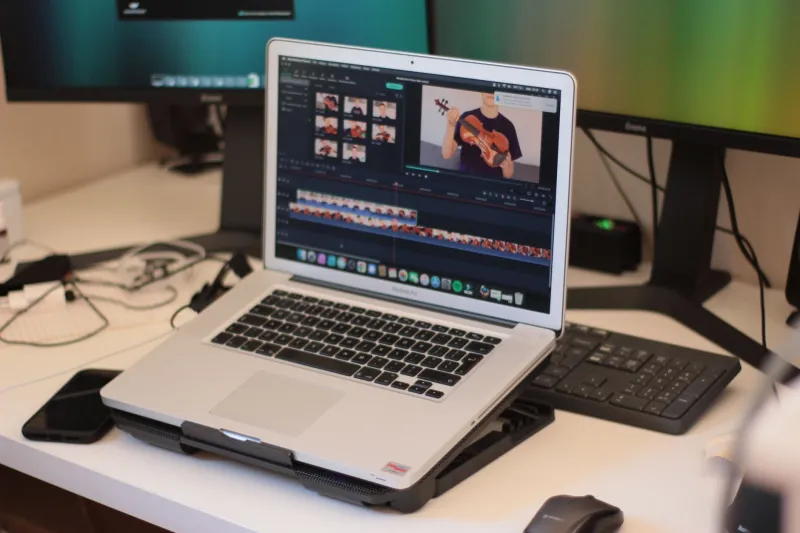
Mirrorless cameras capable of shooting in cinematic color profiles at high frame rates are now priced within reach of individual filmmakers. Non-linear editing software that once required expensive workstations runs efficiently on consumer laptops. AI-assisted audio cleanup tools have dramatically reduced the technical penalty for recording sound in suboptimal conditions—an almost unavoidable reality in rapid-turnaround productions. Color grading applications that previously demanded specialized hardware now operate in browser windows.
The cumulative effect of these developments is that the technical gap between a short film produced in seventy-two hours and one produced over several weeks has narrowed considerably. The remaining gap is almost entirely a function of creative decisions rather than resource limitations. This shift has reframed the short-form production challenge from an exercise in managing technical deficiency to an exercise in maximizing creative clarity.
Studios Mining the Margins
The major studios' interest in short-form production challenges is not purely philanthropic. It is, at its core, a talent acquisition strategy—and an increasingly sophisticated one.
Conventional development pipelines are expensive and slow. A studio evaluating a first-time feature filmmaker based on a single short film is making an assessment with limited data. A filmmaker who has completed a dozen short-form productions under competitive conditions, by contrast, has demonstrated a range of competencies that a single polished short cannot reveal: the ability to make decisions under pressure, to collaborate with unfamiliar crews, to adapt a narrative approach when circumstances demand it, and to complete work on schedule.
Several production companies have moved beyond passive observation of the short-form competition circuit and have begun actively sponsoring challenges, offering development deals as prizes, and embedding creative executives as judges. A24, known for its commitment to distinctive cinematic voices, has engaged with short-form communities in ways that reflect a genuine developmental philosophy rather than mere brand positioning. Netflix's various short-form initiatives reflect a similar recognition that the competition circuit functions as a pre-filtered talent pool.
The underlying logic is straightforward: a filmmaker who can construct a coherent, emotionally resonant narrative in seventy-two hours with minimal resources has demonstrated a form of creative competency that is extraordinarily difficult to fake.
The Constraint as Creative Philosophy
Beyond the competitive and commercial dimensions of short-form production challenges, something philosophically significant is occurring within the filmmakers who engage with them repeatedly.
Many describe a permanent recalibration of their creative instincts—a lasting preference for economy over elaboration, for specificity over scope, for the precisely chosen detail over the comprehensively depicted world. This sensibility, once developed, tends to persist into larger-scale work. Films made by directors who have been through the crucible of extreme short-form production frequently bear its influence: tighter scenes, more purposeful visual choices, a resistance to the kind of narrative padding that afflicts so many mid-budget productions.
The constraint, in other words, does not simply produce better short films. It produces better filmmakers.
In an industry that has invested enormous resources in identifying and developing creative talent, this may be the most significant finding of all. The seventy-two-hour film is not merely a festival novelty or a studio scouting mechanism. It is a form of accelerated creative education—one that the most inventive voices in American independent cinema are increasingly choosing to pursue on their own terms.