The Shrinking Screen: How a Decade of Streaming Has Quietly Rewired the Cinematic Imagination
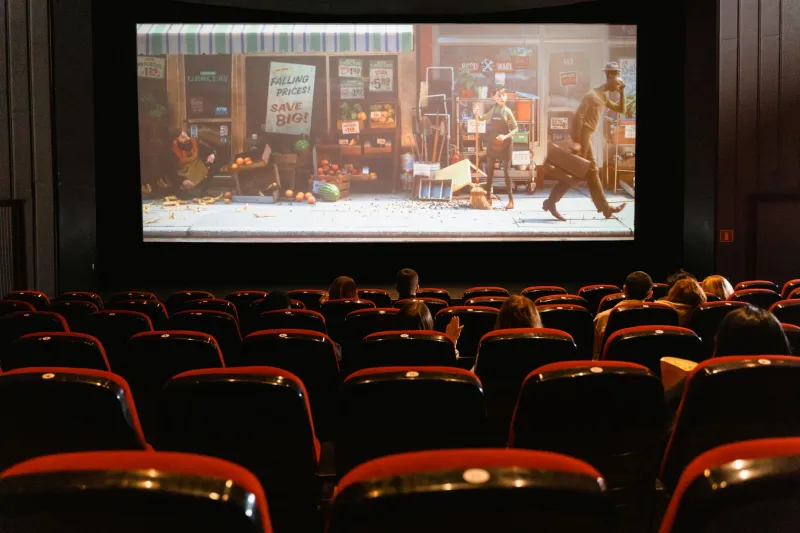
Somewhere between the second and third episode of whatever series a viewer began last Tuesday, something happened that nobody formally announced. The terms of engagement between audiences and moving images quietly renegotiated themselves. The contract that governed how Americans watched films — the one written over nearly a century of theatrical exhibition — was rewritten in the language of autoplay queues, variable playback speeds, and fourteen-inch laptop screens.
The consequences of that renegotiation are only now becoming fully visible. And for filmmakers committed to the expressive possibilities of theatrical cinema, they are worth examining with considerable seriousness.
A Perceptual Recalibration
Human perception is adaptive. The visual and cognitive systems that allow audiences to process moving images are not fixed instruments — they respond to patterns of use. A viewer who has spent the past decade consuming content primarily through streaming platforms has trained their perceptual apparatus on a very specific set of characteristics: compressed aspect ratios, frequent editorial interruption, narratives structured around the anxiety of losing a viewer who can exit at any moment, and the ambient noise of domestic environments that competes with dialogue.
These conditions have produced a viewer with a genuinely different relationship to pace, composition, and silence than the theatrical audience of twenty years ago. This is not a judgment about intelligence or taste. It is an observation about calibration. A musician trained exclusively on compressed MP3 files will hear a vinyl recording differently than one who began with analog sound. Neither is wrong. But they are not listening to the same thing in the same way.
The cinematic equivalent of that gap is now measurable in audience behavior. Films that employ extended takes, deliberate pacing, or compositional strategies that reward sustained attention are increasingly reported by general audiences as slow, confusing, or simply difficult to follow. What was once understood as the grammar of serious cinema now registers, for many viewers, as a kind of malfunction.
What Streaming Platforms Actually Optimized For
It is important to understand that streaming platforms did not set out to diminish cinema literacy. They set out to retain subscribers. Those are related but distinct objectives, and the difference matters enormously.
Retaining subscribers requires minimizing the friction between a viewer and the next piece of content. It requires narrative structures that establish stakes quickly, visual languages that communicate clearly on small screens with modest audio systems, and pacing that accommodates the divided attention of viewers who are also looking at their phones. These are legitimate design choices for the medium they serve. They become problematic only when they are applied as universal standards against which all moving image work is measured.
The difficulty is that for a substantial portion of the American viewing public — particularly younger audiences whose primary experience of film has always been through streaming — these platform-optimized conventions have become the default definition of what film should be. Theatrical cinema, with its different assumptions about audience attention and environmental conditions, is increasingly encountered as a deviation from the norm rather than the origin of it.
The Independent Filmmaker's Dilemma
For independent filmmakers, this perceptual shift creates a genuine strategic dilemma. The films that have historically defined independent American cinema — contemplative, formally adventurous, willing to trust silence and duration — are precisely the films most likely to be experienced as alienating by audiences whose expectations have been shaped by streaming consumption.
The temptation is to accommodate. To edit faster, to hold shots shorter, to front-load exposition, to reduce compositional complexity to what translates on a phone screen. Some independent filmmakers have made exactly this calculation, and their work reaches broader audiences as a result. What it tends to lose, in the process, is the quality that made independent cinema worth defending in the first place.
The alternative — making theatrical work with full formal ambition and accepting the narrower audience that entails — is not a sustainable business model for most independent productions. The economic realities of independent filmmaking in the United States do not accommodate principled obscurity with much generosity.
What is needed, then, is neither capitulation nor retreat. It is something more like translation.
Rebuilding Cinematic Fluency
Several independent filmmakers are approaching this challenge with genuine ingenuity. Rather than treating streaming-conditioned audiences as a problem to be circumvented, they are working to create entry points — moments of immediate sensory engagement that invite viewers into a different mode of attention without demanding it upfront.
This might mean opening sequences that are viscerally immediate before expanding into more contemplative territory. It might mean sound design that rewards headphone listening in ways that make the streaming experience itself more immersive. It might mean theatrical releases accompanied by contextual programming — discussions, introductions, curated short films — that help audiences understand what kind of attention the work is asking for and why that attention is worth giving.
These are not compromises with the medium. They are acts of cinematic hospitality — an acknowledgment that the audience's perceptual landscape has changed and that the filmmaker has a role in helping viewers find their way back to a richer mode of engagement.
The Larger Stakes
Cinema literacy — the capacity to read a film the way a trained reader reads a novel, with sensitivity to form as well as content — took nearly a century to develop as a widely shared cultural competency. Its erosion over the past decade has been rapid and largely unnoticed because it happened incrementally, one autoplay decision at a time.
The stakes of that erosion extend beyond the commercial fortunes of independent film. They involve the question of what kind of imaginative experience Americans have access to — what range of emotional and perceptual engagement moving images can offer when they are encountered on their own terms, in the conditions for which they were made.
Recovering that range is not simply a matter of nostalgia for theatrical exhibition. It is a matter of preserving the full expressive capacity of the medium. And that, for anyone serious about cinema as an art form, is worth considerable effort.